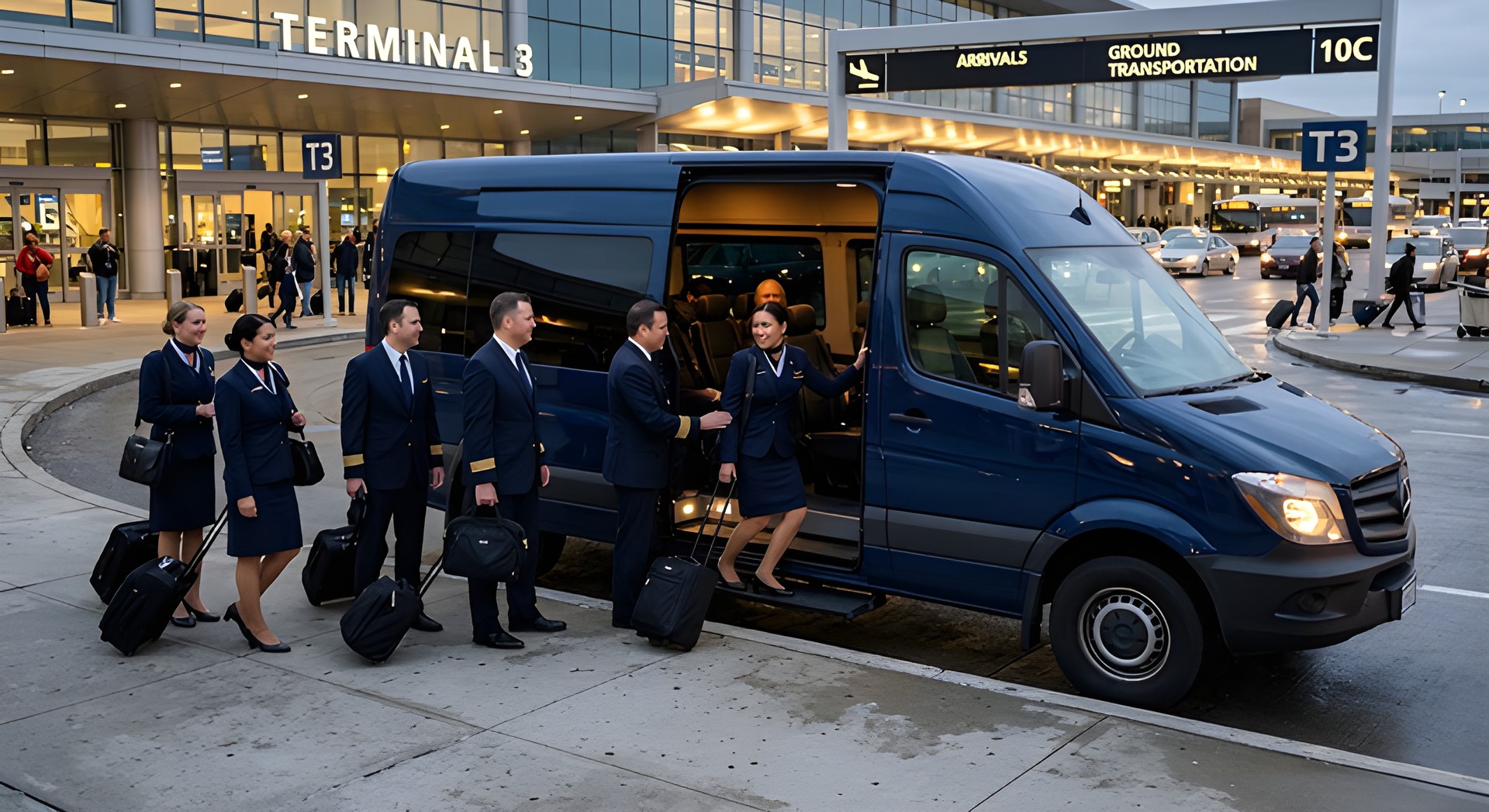
The short answer: crew hotel transportation decides how much of a layover is actually spent resting. Rest rules give crews a fixed window between duties, and every minute spent waiting at the curb or riding in the wrong vehicle comes out of it. Good airline crew transportation is scheduled from the roster, tracks every arriving flight, sizes the vehicle to the crew and their bags, and gives crew schedulers one 24/7 contact for changes.
Why crew hotel transportation matters for rest
Flight crew rest is regulated. In the United States, 14 CFR 117.25 requires a rest period of at least 10 consecutive hours before a flight duty period, and that rest must include at least 8 uninterrupted hours of sleep opportunity. In Canada, Transport Canada's flight crew fatigue rules set a minimum of 10 hours in suitable accommodation when crews rest away from home.
The transfer between the airport and the crew hotel sits inside that window. A late pickup after a long sector, a van that cannot fit the crew's bags, or a driver waiting at the wrong door all push sleep back. That is why airlines and operators treat crew ground transportation as part of their fatigue planning, not as an afterthought.
What good airline crew transportation looks like
- Scheduled from the roster. The provider books every pickup from the crew roster, and updates them when the roster changes.
- Flight-tracked arrivals. Pickups move to the actual landing time, so early arrivals are not left waiting and delays do not cost extra.
- The right vehicle for the crew. One vehicle for the whole crew, with room for roller bags and flight bags.
- Clear pickup points. Drivers know the crew exit or FBO at each station, and crews receive driver and vehicle details before each trip.
- One 24/7 contact. Crew schedulers can change a pickup by phone, email or WhatsApp at any hour.

How roster-based crew transportation works
- Send the roster. Crew bases, layover hotels, flight numbers and report times.
- Agree the vehicle plan. The provider proposes a vehicle for each leg, with a fixed price per vehicle.
- Track and confirm. Arriving flights are tracked and driver details are sent before each trip.
- Handle changes. Irregular operations, diversions and re-crewing are handled by the same team, day or night.
Choosing vehicles for crew size
| Crew size | Vehicle | Typical use |
|---|---|---|
| 1 to 3 | Business sedan | Flight-deck crew, positioning pilots |
| Up to 6 | Business SUV | Narrow-body flight deck and senior cabin crew |
| Up to 14 | Sprinter van | Full narrow-body crew with bags |
| Up to 28 | Minibus | Wide-body crews and combined crews |
| 46–55 | Executive coach | Training groups and large crew moves |
What to ask a crew transportation provider
- Are chauffeurs licensed and insured for commercial passenger transport at each station?
- Which of our crew bases do you cover with your own chauffeurs, and which through partners?
- How do you track arriving flights, and how do pickups change after a delay or diversion?
- Who do our crew schedulers call at 3 a.m., and how fast do they answer?
- Can you book directly from our roster, and how should we send updates?
- What billing options do you offer for airlines and operators?
- How do you protect crew names and roster data?
Private jet and charter crews
Business aviation crews have different pickup points and less predictable schedules. A good provider meets crews at the FBO or private aviation terminal once the aircraft is secured, and plans for short-notice positioning flights. Read how to arrange a car at an FBO for the details.
Airline crew transportation with Black Drive
Black Drive runs airline crew transportation for airlines, charter operators and private jet crews at 100+ airports in 30+ countries, with its own chauffeurs in Canada, the UAE, Saudi Arabia, Qatar and Thailand. Send your roster once and we schedule every crew hotel transfer from it, track every arriving flight and keep one fixed price per vehicle in USD. Billing options for airlines and operators are available on request. Black Drive is a member of the National Limousine Association.
Email crew.ops@blackdriveinc.com or call +1 647 614 7984, 24/7.